What bearers and joists are, and why they go
Bearers are the heavy timbers that run along the tops of the stumps. Joists run across the bearers, closer together, and the floorboards are nailed to the joists. In a West Gippsland house built before the 1970s it is usually hardwood, and all of it has spent decades 300 to 600 mm above damp ground with little air moving past it. Bearers rot where they sit on a stump that is holding water, where a leaking shower or a blocked downpipe has kept one corner wet, and where the end of the bearer is let into a brick pier or buried in the fill under a verandah. Joists rot under bathrooms and laundries, at their ends where they sit on an outside bearer, and wherever the floor above has been wet for years. Termites, which the whole of Baw Baw Shire is deemed prone to, take the rest.
A rotted bearer is why a floor can be bouncy or dipped between two stumps that are themselves fine. It is also why a quote that only counts stumps is only half a quote.
When it is found
Almost always during restumping. The baseboards are off, the house is on jacks, the crew is under the floor with a torch, and the bearer that looked sound from the side is soft when it is probed. That is the cheapest moment to replace it and the worst moment to argue about price, which is why a restumping quote should say in advance how bearer and joist work is charged: per metre of bearer, per joist, and whether the floor coming up is included. The reblocking page covers the sequence.
It is also found by building inspectors before a sale, by pest inspectors who follow termite galleries up from the stumps, and by renovators who lift the bathroom floor and find there is not much holding it up.
How the repair runs
- Find the extent. Rot is probed along the bearer until sound timber is reached. Half a metre of soft timber at a stump often means a metre and a half comes out.
- Support the floor. Jacks and temporary props carry the joists either side of the section being replaced.
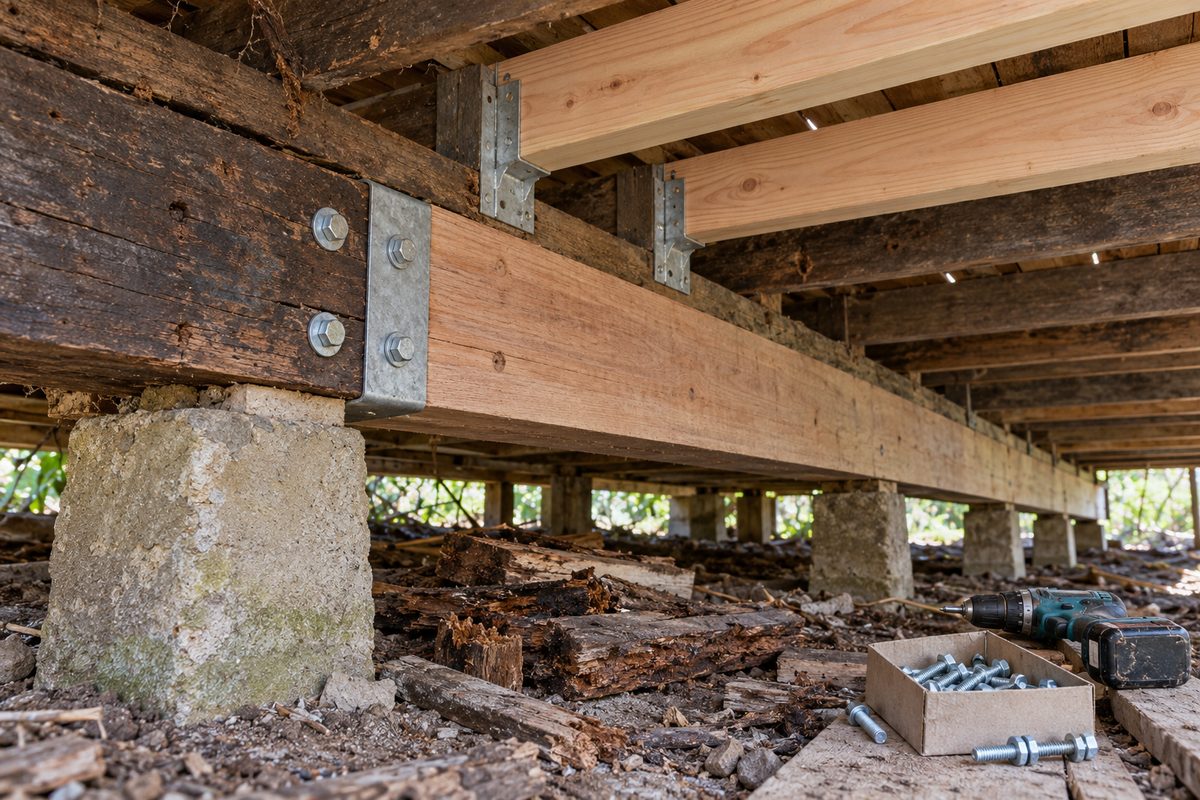
- Cut out and replace. The rotten length is cut back to sound timber over a stump, and a new hardwood bearer of the same section is fitted, bolted to the old with galvanised bolts and a steel splice plate, sitting on the ant cap of the stump below.
- Joists. Rotted joists are cut out and new hardwood joists are fitted in galvanised hangers, or sistered alongside the old where the old is sound enough to help. Under wet areas the floor comes up to do it.
- Treat and ventilate. Where termites were the cause, the timber is treated and the pest controller is brought in. Where damp was the cause, vents are added and the ground regraded, otherwise the new timber is on the same clock as the old.
- Permit. Replacing a bearer or joist that holds up the floor is altering an element that supports other elements, which the Commission's permit practice note excludes from the repair exemption. It is normally covered by the restumping building permit when done together.
What West Gippsland adds
Wet-area corners. The bathroom and laundry corner of a Drouin or Trafalgar weatherboard is almost always the worst. A shower that has leaked for a decade into a subfloor that never dries rots the joists, then the bearer, then the stump, in that order, and the repair goes in the other order.
Verandah bearers. Front verandahs on the interwar bungalows of Warragul sit on short stumps and low bearers close to the ground, under a concrete or timber deck that traps water. They are often the first bearer to go and the easiest to miss.
Hardwood that is still good. The original hardwood in a railway-era house, where it has stayed dry, is as sound as the day it went in. Replacement is done to sound timber, not wholesale, which is cheaper and keeps the floor it was built with.
What bearer and joist repairs cannot fix
They cannot dry out a subfloor. New timber over wet ground rots like the old did, so drainage and vents go with the repair or the repair is temporary. They cannot level a floor on stumps that have failed; the stumps come first. They cannot be done from above alone where the bearer is the problem, the baseboards have to come off and the house has to be supported. And they cannot stop termites coming back to a house with no barrier and no inspection schedule.
Check the current rules before you rely on this
This page describes bearer and joist replacement under homes in Baw Baw Shire. It describes the rules in general terms as they stood in October 2026. Standards, forms, thresholds and fines change.
The authoritative sources are Building and Plumbing Commission practice note BP-01, when is a building permit required, Building and Plumbing Commission (as the VBA) on registration being required for restumping and reblocking at any value and Baw Baw Shire Council property information and building record requests. Where anything here differs from those sources, they are right and we are not.
We are not building surveyors, engineers, planners or lawyers. For what applies to your house, ask a registered building surveyor or ring Baw Baw Shire Council on 03 5624 2411.
Accurate at the time of writing, October 2026. Always check the source before relying on it.